When a pool can't afford to stop, the plumbing should give it options. Cross-coupled manifolds let pumps, filters and sanitisers stand in for each other, so one failed part means a valve change, not a closed pool.
Any pump can feed any filter, and either sanitiser can treat the water.
Dedicated duties
Separate pumps for filtration, features or high-head circuits, each sized for its own job.
Balanced under load
Paths commissioned for equal flow and pressure, not just plumbed and hoped for.
Pumps, filters and sanitisers that can back each other up with a turn of a valve.
How cross-coupling works
01
Shared headers, separate machines
Pumps draw from a common suction header and discharge into a common pressure header. With 3-way diverters and check valves in the right places, each pump can run alone, in parallel with another, or be isolated completely.
02
Check valves stop the backflow
When pumps run in parallel, a check valve on each discharge stops the running pump pushing water backwards through the idle one. Get this wrong and two good pumps fight each other.
03
Two sanitisers, two purposes
Dual sanitation can mean two salt chlorinators sharing the load, or a chlorinator paired with a secondary system. Either way, each cell gets its own isolation so one can be cleaned or replaced while the other keeps the water safe.
04
Order matters
Heating comes before the chlorinator, so strongly chlorinated water from the cell doesn't pass straight through a heat exchanger. The sanitiser sits last before the returns.
Why not just one bigger pump?
A single large pump is a single point of failure, and it's usually oversized for most of the hours it runs. Two or three smaller pumps, each matched to a duty, can run slowly and quietly for filtration and come together only when a feature or high-head circuit needs the extra flow. When one needs service, the others keep the pool running.
Parallel pumps and the system curve
Two identical pumps in parallel don't double the flow through a given set of pipes. The extra flow raises friction, so the gain is always less than you'd expect. The real figure depends on the pipework. That's why we work from the system curve, how head rises with flow in your actual plumbing, rather than adding up numbers from a brochure.
Our reference build
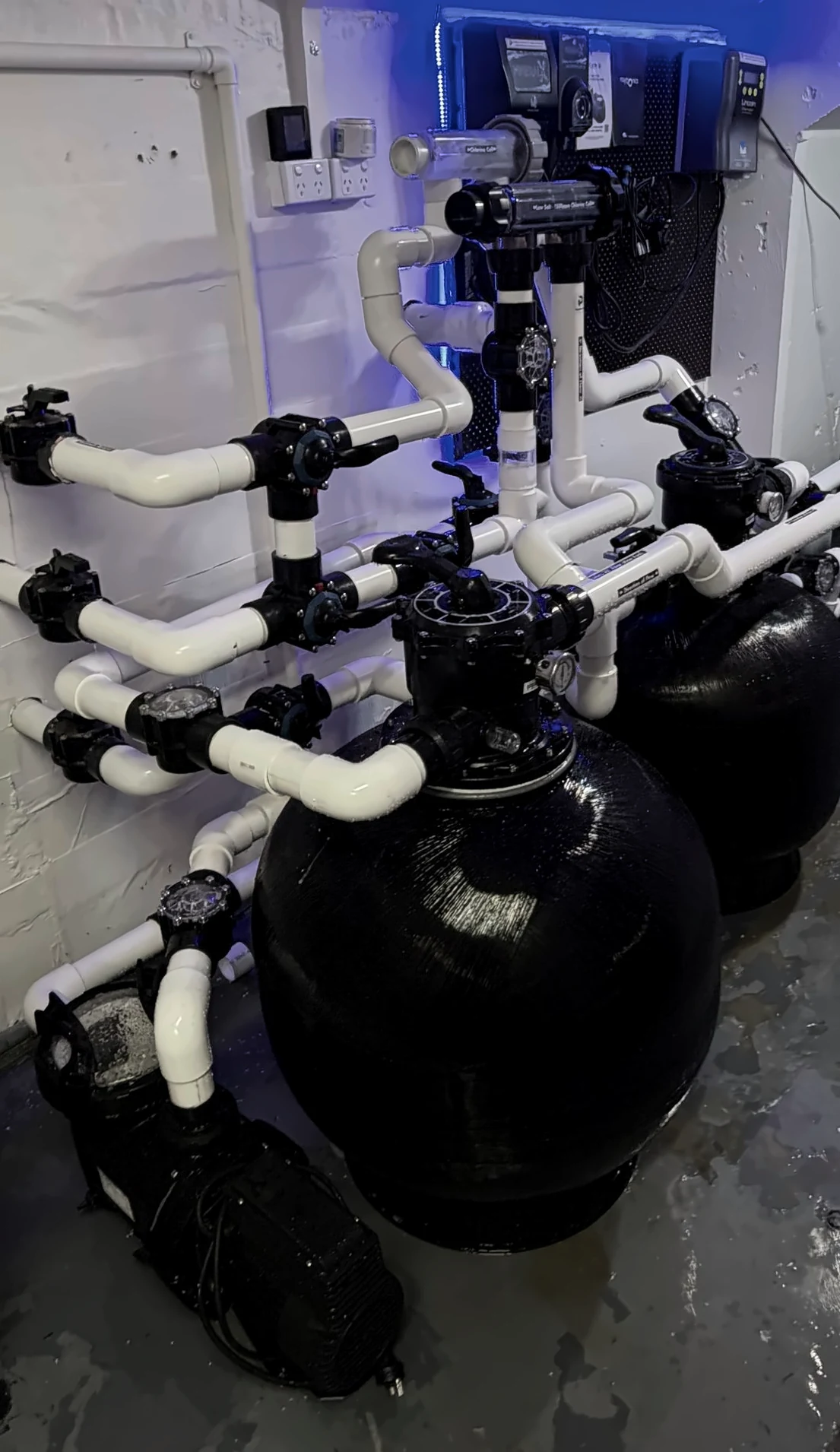
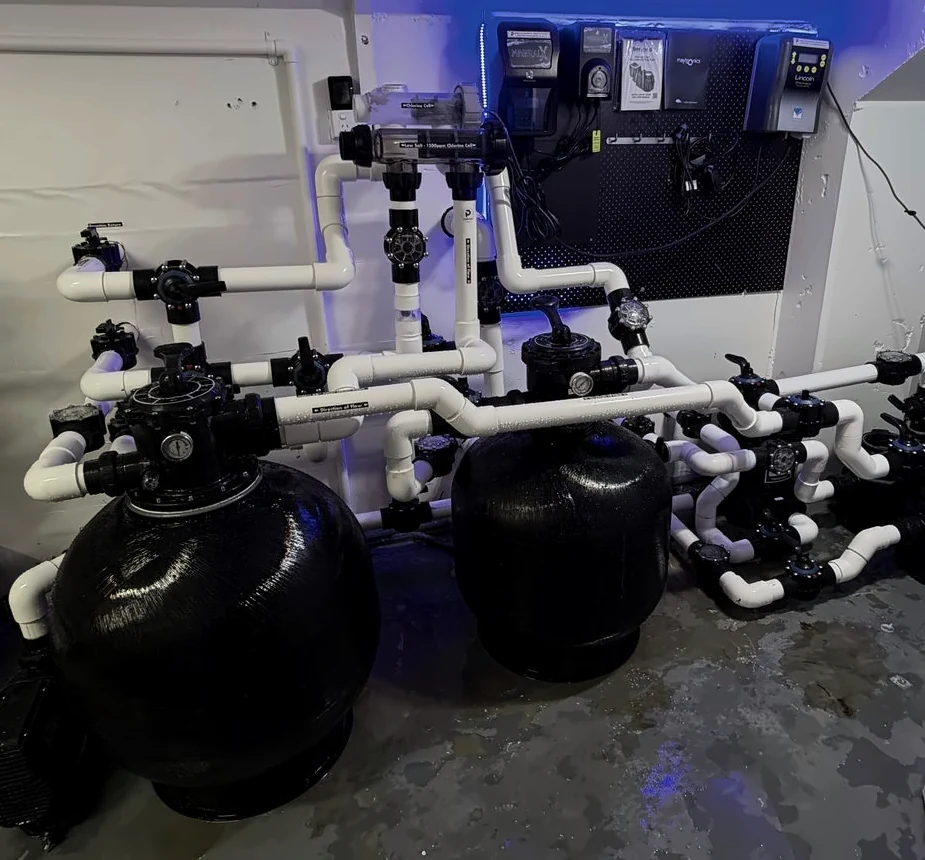
Our triple-pump, dual-chlorinator cross-coupled plant room is a worked example of this approach: three pumps, twin fibreglass filters and two chlorinators, all able to back each other up, with each line individually plumbed into the manifold.
A cross-coupled white PVC pool manifold joining two fibreglass filters, with the pool controllers mounted above.
What we measure and specify
Duty of each pump: filtration, features, high-head circuits
Check valve type and position on every discharge
Diverter positions for every operating mode
Sanitiser sizing against the pool's real demand
Heater-before-chlorinator order confirmed
Balanced flow and pressure across twin paths
What you get
No single point of failure
A failed pump, filter or cell means a valve change, not a closed pool.
Quieter everyday running
Smaller pumps on slow filtration duty, with extra capacity only when needed.
A mode chart
Valve positions for every operating mode, written down and left on site.
Questions
Cross-Coupled, Multi-Pump & Dual-Sanitiser Plumbing: common questions
Do I need two chlorinators?+
Not always. Dual sanitation suits pools with high or variable demand, or where downtime isn't acceptable. We look at volume, bather load and how critical uptime is before recommending it.
Can existing pumps be cross-coupled?+
Often, yes, if they're compatible and in good condition. We check each pump's curve and condition before designing around it.
Will parallel pumps double my flow?+
No. Friction rises with flow, so two pumps in parallel always deliver less than double. The real gain depends on the pipework, which is why we calculate it.
Is this the same as the plant room in your case study?+
That build uses this approach. Each design is one-of-one, sized to the pool and the site.